
State the basis: as-is vs dry basis
Moisture is normally reported as-is. If a laboratory converts to dry basis, the number is higher and must not be compared with as-is limits. Always write the basis next to the value.
Technical Data Library · Parameter Dictionary
Moisture, reducing sugars, sulphite, bulk density, particle size, rehydration, microbiology — what each parameter means, which unit and basis it is measured on, which reference values apply, and why procurement should look at it. Built on USDA A-A-20032H, EU 1333/2008, Codex CXS 193-1995 and GB 2762/GB 2760.
Parameter dictionary
Each row names the definition, the unit and basis of measurement, an authoritative reference value where one exists, and the procurement reason to check it. Reference values are marked with their source: USDA A-A-20032H, EU 1333/2008, Codex CXS 193-1995 or GB limits.
| Parameter | Definition | Unit / Basis | Typical reference value | Why procurement checks it |
|---|---|---|---|---|
| Moisture (as-is vs dry basis) | Water content of the dried ingredient. "As-is" reports water in the product as received; "dry basis" expresses the other components relative to bone-dry matter. | % w/w · state the basis (as-is or dry basis) | USDA A-A-20032H: ≤ 9.0 % as-is (flakes); ≤ 9.5 % as-is (granules / instant mash) | Drives price-per-solids, shelf stability, caking, flow and how much dry matter your recipe actually receives. |
| Reducing sugars | Glucose and fructose that remain in the dried potato; they react with amino acids during frying or baking (Maillard) to form colour and flavour. | % w/w as-is, glucose equivalent | USDA A-A-20032H: ≤ 4.0 % (flakes) | Controls fry colour and browning in fabricated chips and snacks; light fry colour is specified with a low-sugar grade. |
| Sulphite (SO₂) | Residual sulphite added as preservative / anti-browning agent, expressed as SO₂, covering E 220–E 228. | mg/kg as SO₂ | EU 1333/2008: ≤ 400 mg/kg (dehydrated potato products); USDA A-A-20032H: ≤ 500 mg/kg (flakes) / ≤ 600 mg/kg (granules) | The legal limit differs by destination; it also touches label declaration and sulphite-sensitive consumers. |
| Bulk density | Mass of the loose powder per unit volume, including inter-particle air. | g/ml or g/L, loose and/or tapped | No universal limit — fixed per grade in the signed specification | Determines bag fill weight, dosing volume, mixing behaviour and packaging economics. |
| Particle size / sieve analysis | Distribution of flake or granule dimensions, measured by sieve stack or mesh aperture. | mesh or mm · % retained on each sieve | Fixed per grade in the signed specification (e.g. flakes: % through a named mesh) | Particle profile decides rehydration speed, dosing behaviour, dust and finished texture. |
| Water absorption / rehydration ratio | Mass of water absorbed per mass of dry ingredient under defined water temperature, time and mixing; the rehydration ratio is hydrated weight over dry weight. | g water / g dry, or hydrated/dry ratio | Application-specific — measured under your water ratio; no universal limit | The most application-critical behaviour; small changes alter yield, mouthfeel and line settings. |
| Cold-water viscosity (pregelatinized) | Viscosity developed when the powder is dispersed in cold water; relevant for pregelatinized grades used in instant systems. | cP or mPa·s under defined temperature, solids and shear | Grade-specific, fixed in the specification | Predicts body and thickening in instant soups, sauces and dry mixes without cooking. |
| Degree of gelatinization | Share of starch cooked / gelatinized during processing, expressed as a percentage of total starch. | % gelatinized starch | Grade-specific (e.g. ≥ 90 % for pregelatinized grades) | Confirms cold-water functionality and separates pregelatinized from native-type products. |
| Cell damage / free starch (blue value index) | Amount of starch released from ruptured potato cells during processing, measured by iodine blue colour. | Blue value index (absorbance-based) | Grade-specific; lower is better for mash texture | Damaged cells release free starch that makes mash sticky and gluey; a low index keeps a fluffy texture. |
| Colour / black specks | Visual lightness of the powder and the count of dark specks, rated against a standard. | Instrumental L*a*b* or visual standard / specks per unit weight | Fixed per grade in the signed specification | Visible appearance correlates with raw material quality and process control; it affects finished colour. |
| Microbiology (APC / yeast & mould / Salmonella / E. coli) | Aerobic plate count, yeast & mould counts, and presence or absence of pathogens such as Salmonella and E. coli. | CFU/g; Salmonella / E. coli: present or absent in a defined sample size | USDA A-A-20032H: APC < 100,000 CFU/g, Salmonella negative; granules: yeast & mould < 100 CFU/g | The food-safety gate for the destination market; limits belong in the signed spec and are verified per lot. |
| Heavy metals (Pb, Cd, As) | Lead, cadmium and arsenic residues from soil and processing, controlled as contaminants. | mg/kg | Direction of Codex CXS 193-1995 and GB 2762; limits vary by market | Mandatory contaminant compliance; exceedance blocks import clearance regardless of other quality. |
| Pesticide residues | Residues of plant-protection products used in potato growing, remaining in the dried ingredient. | mg/kg per active substance | MRLs per destination regulation (e.g. EU 396/2005 framework) — not set by USDA A-A-20032H | MRL compliance is a precondition for customs release in most markets. |
| Allergens | Declared presence or absence of regulated allergens from raw material or shared production lines. | Declarative statement + ppm where required | Per destination labelling rules; potato is not a regulated allergen but cross-contact must be declared | Protects label claims, avoids recall risk and supports your customer’s allergen management. |
Values above are authoritative references, not contract guarantees. Contractual limits, test methods and acceptance rules are fixed in the signed specification and verified by the lot COA.
Testing basis
A parameter without a stated method and basis is not comparable. Four rules make laboratory numbers reliable.
Moisture is normally reported as-is. If a laboratory converts to dry basis, the number is higher and must not be compared with as-is limits. Always write the basis next to the value.
Reference methods such as AOAC 925.10 / ISO 712 (moisture), AOAC 963.19 (SO₂) or the method in your specification must be cited with the edition, because editions change tolerances.
When two laboratories disagree, the contract should name one referee method and one accredited laboratory whose result is final. Sampling and sample preparation are part of the method.
Every result carries uncertainty from sampling and analysis. A result “at the limit” is not automatically compliant or non-compliant; the specification should define how uncertainty is treated.
COA fields
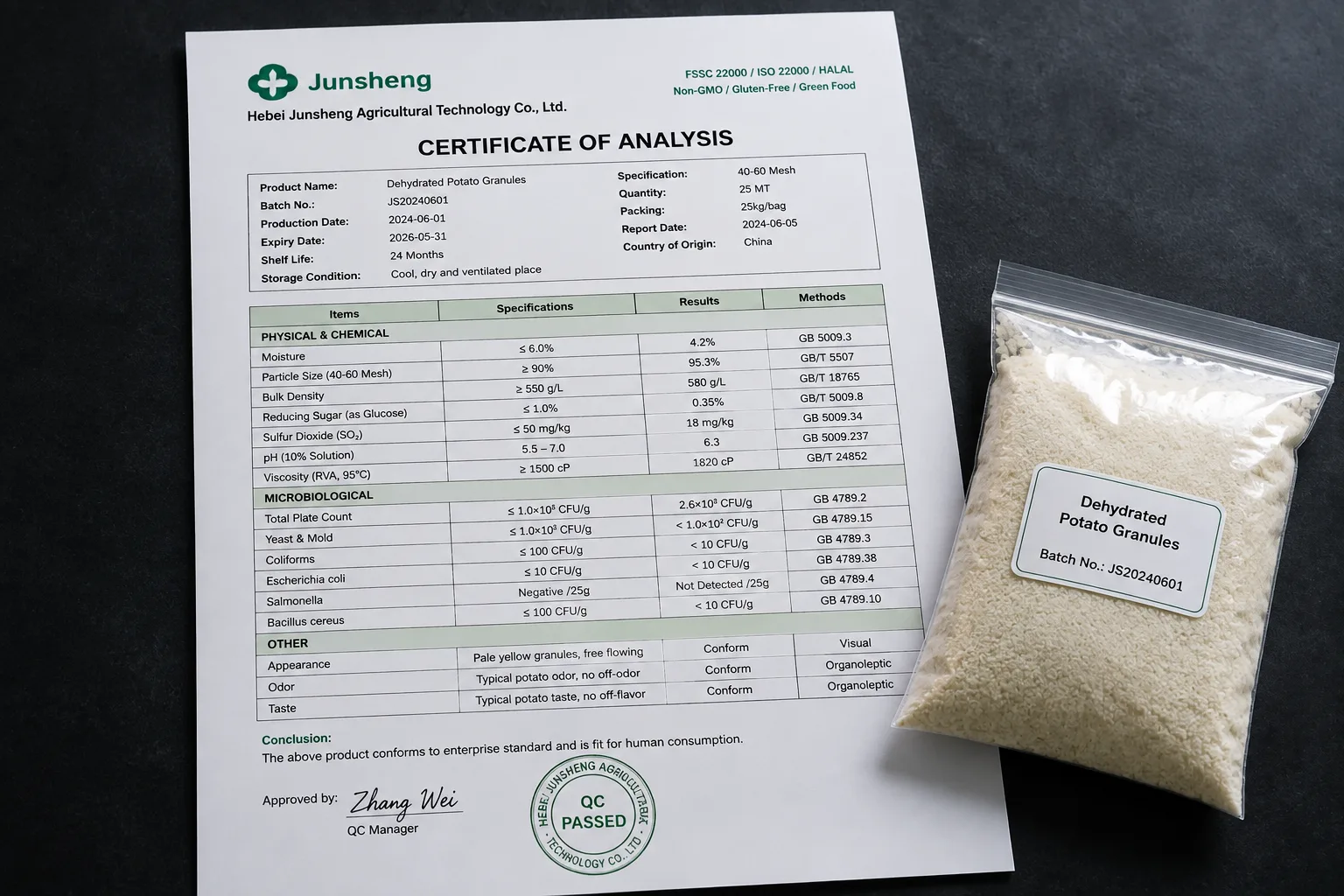
A Certificate of Analysis reports one lot, one production date, one set of methods and one set of results. The fields below appear on most dehydrated potato COAs.
| Field | What it states | Buyer check |
|---|---|---|
| Lot / batch number | Unique identifier of the production lot | Traceability link to production records and your own intake log. |
| Production & expiry dates | Manufacturing and best-before dates | Confirm the COA matches the lot physically shipped to you. |
| Moisture (as-is) | Water content measured on the lot | Compare against the as-is limit; watch the stated basis. |
| Reducing sugars | Glucose / fructose content | Critical for fry colour when you fabricate chips or snacks. |
| Sulphite (SO₂) | Residual sulphite as SO₂ | Check the destination limit (e.g. EU 400 mg/kg) and the label declaration. |
| Particle size distribution | % retained per sieve | Confirm it matches the grade you specified. |
| Bulk density | Loose / tapped density | Affects your dosing and bag fill weight. |
| Microbiological results | APC, yeast & mould, Salmonella, E. coli | Verify against spec; pathogen results must be negative. |
| Heavy metals | Pb, Cd, As results | Confirm compliance with destination contaminant rules. |
| Test methods & signatory | Methods used and QC release | Check the methods match the specification and the certificate is authorized. |
FAQ
Typical causes are differences in sampling and sample preparation, different editions of the test method (for example AOAC 925.10 / ISO 712 for moisture or AOAC 963.19 for sulphite SO2), moisture pick-up during transport or storage, and measurement uncertainty. On the same lot, one laboratory may report moisture as-is at 8.6 % while another converts to dry basis and reports 9.4 % — the two numbers are not comparable unless the basis is stated. The contractual fix is to name one method edition, one accredited arbitration laboratory, the sampling plan and the decision rule for results sitting at the limit; then results become reproducible. On our technical data sheet every parameter row states the unit and basis, and the same discipline must appear in the potato flakes specification and its COA.
The values published here are authoritative references — USDA A-A-20032H, EU 1333/2008, Codex CXS 193-1995 and GB 2762 — that help you understand each parameter and the requirement of the destination market. For example, moisture for potato flakes is ≤ 9.0 % as-is under USDA A-A-20032H while granules are allowed ≤ 9.5 %; reducing sugars are capped at ≤ 4.0 %; residual sulphite SO2 is ≤ 500 mg/kg for flakes and ≤ 600 mg/kg for granules, but EU 1333/2008 limits dehydrated potato products to 400 mg/kg, so the stricter destination rule governs. Contractual limits, test methods and acceptance rules are fixed in the signed specification and verified by the lot COA. Where destination law is stricter than any reference, the law governs, so the potato flakes specification you sign should carry the destination value.
Write the full method reference with its edition — for example AOAC 925.10 or ISO 712 for moisture, AOAC 963.19 for sulphite SO2, ISO 6579 for Salmonella — plus the sampling plan, sample preparation, the accredited arbitration laboratory and the decision rule when a result sits exactly at the limit. State whether moisture is reported as-is or dry basis, because the same lot produces different numbers on the two bases. Add how measurement uncertainty is treated, since every result carries uncertainty from sampling and analysis. Verbal agreement cannot be enforced; only the signed potato flakes specification and its COA give you a defensible basis in a dispute.
A COA (Certificate of Analysis) is issued per production lot and must correspond to the physical lot shipped to you — it is a per-lot document, not a periodic one. Each COA reports the lot number, production date, test methods and results for moisture, reducing sugars, sulphite SO2, bulk density, particle size, microbiology and heavy metals. On arrival, your incoming inspection can re-test by the agreed method (for example moisture by AOAC 925.10 as-is) and compare with the certificate. If results diverge, the arbitration method and laboratory named in the specification decide, including how measurement uncertainty is treated.
A potato flakes COA typically includes the lot and production date, moisture as-is (≤ 9.0 % per USDA A-A-20032H), reducing sugars (≤ 4.0 %), residual sulphite SO2 (≤ 500 mg/kg, or ≤ 400 mg/kg for EU destinations), bulk density, particle size distribution on a defined mesh, water absorption, cold viscosity, gelatinization degree and free starch (blue value index) for pregelatinized grades, plus microbiology (APC < 100,000 CFU/g, Salmonella negative) and heavy metals checked against GB 2762 and Codex CXS 193-1995. Each field names the test method and its edition so the numbers can be compared with your potato flakes specification. Ask your supplier to attach the full technical data sheet and the signed COA before shipment.
Moisture is normally measured on the product as received (as-is) by drying to constant weight, typically by AOAC 925.10 or ISO 712, and reported in % w/w. Under USDA A-A-20032H, potato flakes must be ≤ 9.0 % as-is and granules / instant mash ≤ 9.5 % as-is. If a laboratory converts to dry basis, the number is higher (for example 9.0 % as-is is roughly 9.9 % dry basis) and must never be compared with an as-is limit. Always write the basis and the method edition next to the value in the technical data sheet, and specify the same basis in the potato flakes specification to avoid disputes.
Fry colour is driven mainly by reducing sugars (≤ 4.0 % per USDA A-A-20032H) and moisture; texture by water absorption, cold viscosity, gelatinization degree and free starch (blue value index); dosing and bag fill by bulk density and particle size mesh (sieve analysis) results. Food safety is covered by residual sulphite SO2 (EU 1333/2008: ≤ 400 mg/kg), microbiology (APC < 100,000 CFU/g, yeast & mould < 100 CFU/g for granules, Salmonella negative) and heavy metals per GB 2762 and Codex CXS 193-1995. Every one of these appears on the lot COA with its test method, so the technical data sheet and the potato flakes specification together close the loop.
Authoritative references
Send the specification draft or a COA — our technical team will explain each field and check it against destination requirements.
Start a technical inquiry
Share your product, destination market, specification draft and volume — we will prepare the technical file and comparable samples.
TECHNICAL REVIEW · METHODS & ACCEPTANCE
Technical data is only comparable when the method, sample basis, unit and test conditions are clear. Use this section to identify the parameters that should be controlled during incoming inspection, line trials and lot release.
Reference values are not a substitute for an agreed commercial specification. Confirm the method version and acceptance limit in the TDS or contract, then verify each supplied lot with the relevant COA or test record.
Check method version, units and sample preparation before comparing values.
Focus on the technical parameters that influence quality and application performance.
Use agreed specifications, COA data and traceability records for acceptance.