Comparison FAQ
Questions buyers ask when comparing forms
01Which form is "best" — flakes, granules or pregelatinized potato flour?+
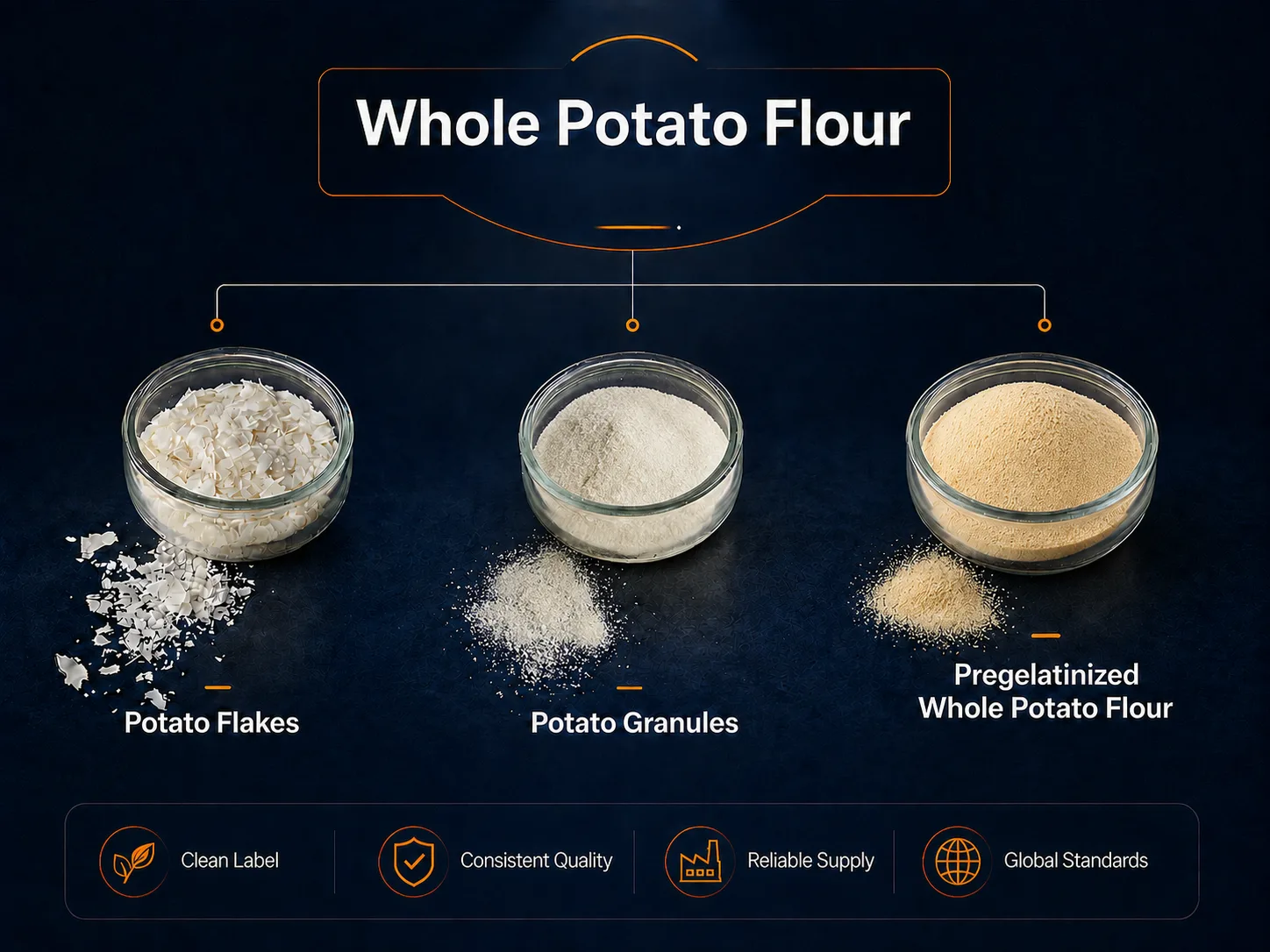
Dehydrated potato ingredients are available as fine flour, flakes, granules and pregelatinized forms — related raw material, different processing routes and different functional jobs. None of the working forms is universally best: flakes favour mash and formed textures, granules favour uniform reconstitution and dosing precision, and pregelatinized flour favours instant cold systems. Choose by finished product and process, then confirm with a trial at your water ratio, mixing speed and resting time; reference moisture is ≤ 9.0% for flakes and ≤ 9.5% for granules under USDA A-A-20032H. Reference specifications and comparison samples are available for side-by-side trials.
02Can flakes be replaced by whole potato flour at the same weight?+
No — never substitute by equal weight without a trial. Whole potato flakes and whole potato flour differ in water absorption, dosing behaviour and texture: flakes rehydrate fast with a classic mash structure, while fine dehydrated potato flour disperses in liquids and behaves differently in the mixer. Start with a smaller water addition, record hydration, lumping and dough yield at your mixing speed, then adjust before scaling up. ✓ Reference guidance for flakes: moisture ≤ 9.0%, reducing sugars ≤ 4.0%, SO₂ ≤ 500 mg/kg (USDA A-A-20032H); confirm grade limits in the signed specification.
03Why do granule and flake sulphite references differ?+
Process routes and additive handling differ, so the USDA A-A-20032H reference basis lists different maxima: flakes ≤ 500 mg/kg SO₂, granules ≤ 600 mg/kg SO₂, with moisture ≤ 9.0% for flakes and ≤ 9.5% for granules. The contractual limit always follows destination rules — EU 1333/2008 caps sulphites in dehydrated potato at 400 mg/kg, and GB 2760 applies for China-bound goods — so the signed specification and the lot COA are the binding documents. ✓ Ask our export team for a COA that matches your destination port and standard.
04How should I test two forms on water absorption?+
Run a controlled side-by-side trial: same water ratio, temperature, mixer speed and resting time, and record hydration, lumping, texture, colour and yield for both forms. Water absorption and reducing sugars drive the outcome — reducing sugars ≤ 4.0% (reference) control browning, while absorption decides how much water your formula needs. ✓ Repeat with your actual production water, keep a comparison log, and verify the lot against its COA before you commit a container.
05Potato flakes vs granules — which suits my bakery or instant-mash line?+
Choose by the job, not the label. Whole potato flakes rehydrate fast into a classic mash or formed texture and suit mash, snacks and bakery binding; whole potato granules reconstitute into a finer, more uniform texture and meter precisely for dosing-critical dry blends. Both are established forms within the dehydrated potato ingredient range, and both must be tested at your water ratio before you commit. ✓ Reference: flakes moisture ≤ 9.0%, granules moisture ≤ 9.5%, reducing sugars ≤ 4.0% (USDA A-A-20032H); order samples of both from our China factory and run your line trial.
06What MOQ, COA and bulk-supply options are available for potato flakes and potato granules?+
We support trial quantities and full-container supply — from trial cartons to full container loads — for bulk potato flakes, bulk potato granules and pregelatinized potato flour. Every shipment includes a lot COA covering moisture, reducing sugars, SO₂, microbiology and particle size against the signed specification, and bulk pricing is quoted by volume and destination port. ✓ Contact the export team with your target quantity and port for a firm MOQ quotation and document list.
07Can I export pregelatinized potato flour and dehydrated potato ingredients in full containers from China?+
Yes — we export dehydrated potato flour, potato flakes, potato granules and pregelatinized potato flour in 20 ft and 40 ft containers to food manufacturers worldwide, with export documents for customs and destination compliance. Pregelatinized potato flour hydrates and builds viscosity in cold water without cooking, which shortens preparation time in instant soups, sauces and fillings. ✓ Tell us your port, container size and required standards for a shipping plan, packing proposal and COA.