
What is the finished product?
Snack, instant mash, bakery item, soup, sauce, pet food or prepared food defines the required potato character and solids.
Product Selection Center · Application-Led Procurement
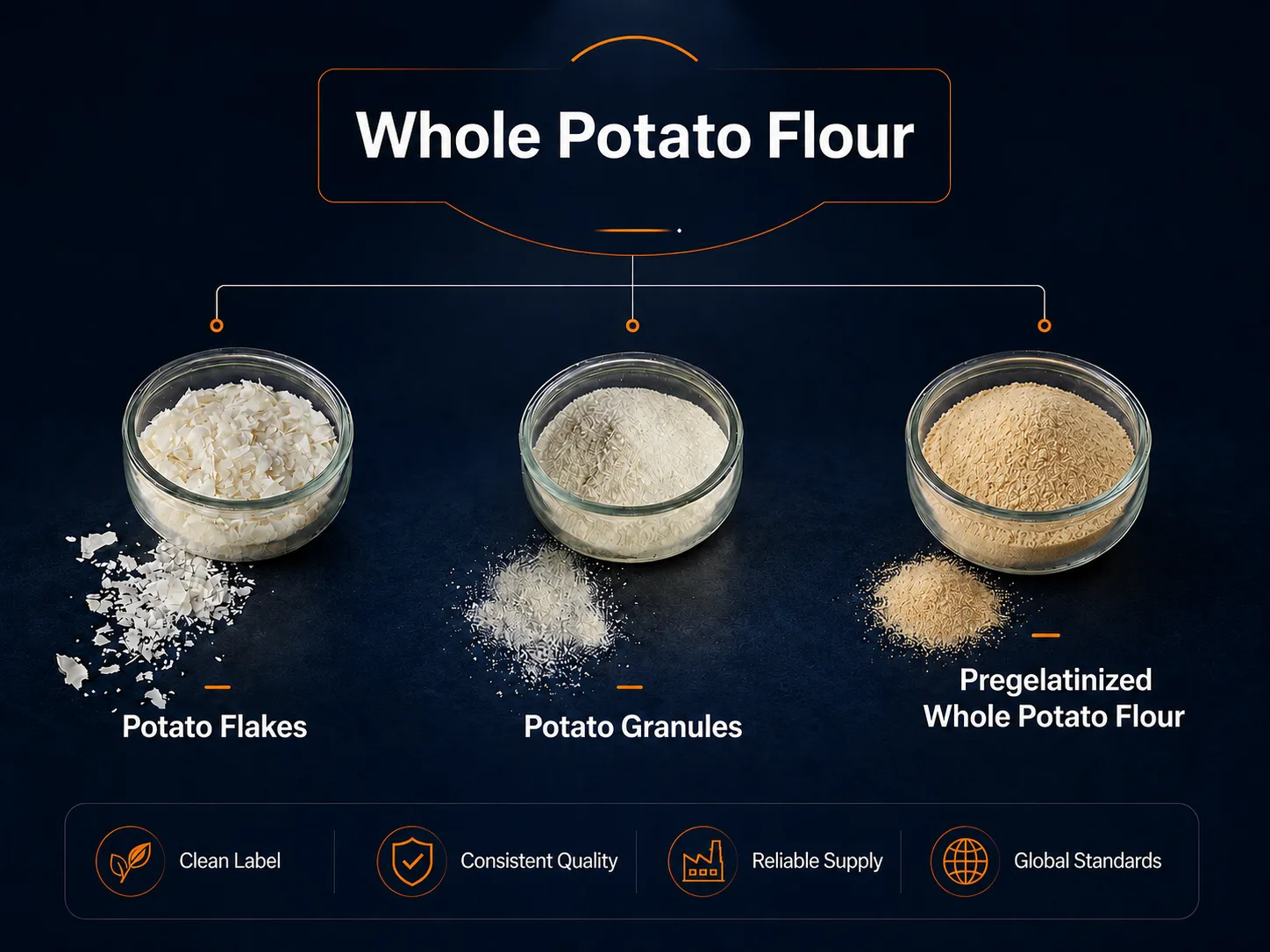
Dehydrated potato flour, flakes, granules and pregelatinized flour behave differently in production. This center maps finished products and process conditions to the most suitable form using measurable parameters rather than product names alone.
Selection flow
The same product name can behave differently across factories. Answer these five questions and the suitable form, particle profile and specification fields become clear.
Snack, instant mash, bakery item, soup, sauce, pet food or prepared food defines the required potato character and solids.
Hot water, cold water, mixer, steamer or line dosing changes the hydration behaviour the ingredient must survive.
Frying, baking, retorting, freezing or high-shear mixing each place different demands on texture stability.
Texture, viscosity, colour, yield, dispersion or shelf stability should be ranked before sampling.
COA, allergen, halal, contaminant limits and destination standards affect specification and approval.
Direction table
Reference direction only. Confirm the final grade through a laboratory trial under your actual process conditions.
| Finished product | Recommended direction | Why |
|---|---|---|
| Fabricated chips, formed snacks & pellets | Potato flakes | Flake form within the whole-potato-flour range builds potato solids, dough body and controlled texture; reducing-sugar level is specified for fry colour. |
| Instant mashed potato & potato-based side dishes | Potato flakes or granules | Flakes give fast rehydration and classic mash texture; granules give a finer, more uniform reconstituted mouthfeel — both sub-forms of whole potato flour. |
| Bread, rolls, bakery fillings & dough systems | Dehydrated potato flour or flakes | Whole-potato solids support moisture retention, softer crumb and mild potato flavour at low addition levels. |
| Instant soups, sauces, gravies & dry mixes | Pregelatinized potato flour | Pregelatinized whole potato flour gives cold-water dispersibility and rapid viscosity build to shorten preparation time in instant systems. |
| Pet food, feed binders & functional binding | Potato flakes or dehydrated potato flour | Controlled hydration, structure and water binding support extrusion and shaping lines. |
| Frozen prepared foods & formed products | Potato flakes or granules | Stable texture through freeze–thaw and reheating improves finished-product consistency. |
Values in the signed specification and lot COA, not this table, govern the purchase.
Selection factors
Listed fields follow the reference basis of dehydrated potato specifications (USDA A-A-20032H) and Codex compliance documents.
Flake, granule or powder changes hydration speed, dosing and finished texture.
Moisture basis and limit must be named (as-is vs dry basis) for fair comparison.
Relevant when fry colour, browning or flavour development is a target.
The single most application-critical behaviour; test with your water ratio.
Affects bag fill weight, dosing volume and mixing behaviour.
Visible appearance correlates with raw material and process control.
APC, yeast & mould, Salmonella and E. coli limits follow the signed spec.
Residual level must comply with destination additive rules (EU 1333/2008, GB 2760).
Grade directions
These four guides cover dehydrated potato flour, potato flakes, potato granules and pregelatinized potato flour. Each page explains process behaviour, measurable specifications and practical buying questions in six languages.
Fine dehydrated potato flour for hydration, dry blending and flavour delivery. Compare it with flakes, granules and pregelatinized flour by particle profile, hydration behaviour and application.
Open guide →Fast-rehydrating flake form for mash, snacks, bakery and binding applications.
Open guide →Fine-granule form for uniform reconstitution and precise dosing.
Open guide →Cold-water thickening and instant functionality for dry-mix systems.
Open guide →Selection FAQ
Names overlap between markets and suppliers, and the same word can describe very different materials. Hydration behaviour, particle profile, moisture, colour and reducing sugars all differ by grade, so the agreed specification and a side-by-side trial decide the fit. Always compare measurable parameters — water absorption, particle size, moisture and reducing sugars — and confirm the grade with the lot COA. Ask for these fields in the technical data sheet before you sample.
Request two candidate forms or grades — for example potato flakes vs granules vs flour — and test them with the same water ratio, mixer and measurement method. A single sample cannot show the difference the process makes, so run a side-by-side trial that records rehydration time, water absorption, viscosity and fry colour under identical conditions. Tell the supplier the finished product and water addition so samples are cut to your line, and ask for the batch COA with each sample. This gives purchasing and R&D teams enough evidence to approve the most suitable grade before any MOQ commitment.
No. The figures published here are authoritative references, not contractual guarantees. As a reference, USDA A-A-20032H sets flake moisture at no more than 9.0%, reducing sugars at no more than 4.0% and SO₂ at no more than 500 mg/kg, while granules allow moisture up to 9.5% and SO₂ up to 600 mg/kg; EU regulation 1333/2008 caps SO₂ at 400 mg/kg for dehydrated potato products. Contractual limits, test methods and acceptance rules are fixed in the signed specification and verified on every lot COA. Name the same fields — moisture, reducing sugars, water absorption and SO₂ — in your supplier-qualification inquiry.
Yes. Qualified inquiries receive technical data sheets, COA samples, allergen and halal statements and destination-compliance guidance for the destination market you specify. We also share application notes on water absorption, reducing sugars and fry colour so your team can compare forms before sampling. If you are a bulk buyer, ask for the MOQ schedule, packing options, lead time and port terms together with the documents.
Potato flakes, granules and fine dehydrated potato flour are distinct forms within the dehydrated potato ingredient range: fine flour suits hydration and dry blending, flakes rehydrate quickly for mash, snacks and bakery, and granules provide uniform particles for precise dosing. Potato flakes vs granules vs flour therefore comes down to hydration speed, particle profile and finished texture, not to different product families. For whole potato flour selection, match the form to the application — instant mash and fabricated chips favour flakes, dry mixes favour pregelatinized potato flour, and soups and sauces can use fine flour. Your supplier should provide water absorption and rehydration data for each form so the comparison is measurable.
Water absorption is the single most application-critical behaviour: it decides dough yield, dosing and finished texture, so test every candidate with your exact water ratio. Reducing sugars drive fry colour and browning — a higher reducing-sugar level darkens fried snacks — which is why the spec must state the limit (USDA A-A-20032H references flake reducing sugars at ≤4.0%). When whole potato flour selection is done properly, flakes for fabricated chips are specified for fry colour, granules for uniform reconstitution and pregelatinized potato flour for cold-water viscosity. Run a small sample comparison trial at your plant and record colour, absorption and yield before ordering.
For bulk supply, MOQ is set by product form, shipment size and destination port, and every lot ships with a COA covering moisture, reducing sugars, water absorption, SO₂, microbiology and colour. Export documentation can include certificate of origin, phytosanitary and halal/allergen statements where required, plus destination-compliance guidance for the EU and other markets. Share your volume, destination port and required documents in the inquiry, and we return the MOQ schedule, pricing basis and sample plan for whole potato flour selection.
Authoritative references
Send the finished product, water addition, process and target result — we return a selection recommendation with comparable samples.
Start a selection inquiry
Share finished product, process conditions, target performance and volume for a grade recommendation.
APPLICATION FIT · FORMULATION & LINE TRIAL
Application pages are most useful when the ingredient is evaluated under your real water ratio, mixing sequence, temperature, shear and holding time. Compare forms by the result they produce in the finished food, not by name alone.
Record texture, hydration or viscosity, colour, yield and processing stability during the trial. Use those results to select a grade and define the specification fields that matter to your line.
Define water addition, mixing, heat, shear and downstream process.
Measure the finished-product results that matter to the application.
Select the form and specification after a controlled side-by-side trial.