
Whole Potato Flakes
Economy · Food · Bakery · Feed · BulkFast-rehydrating flake form for mash, fabricated chips, snacks, bakery and binding.
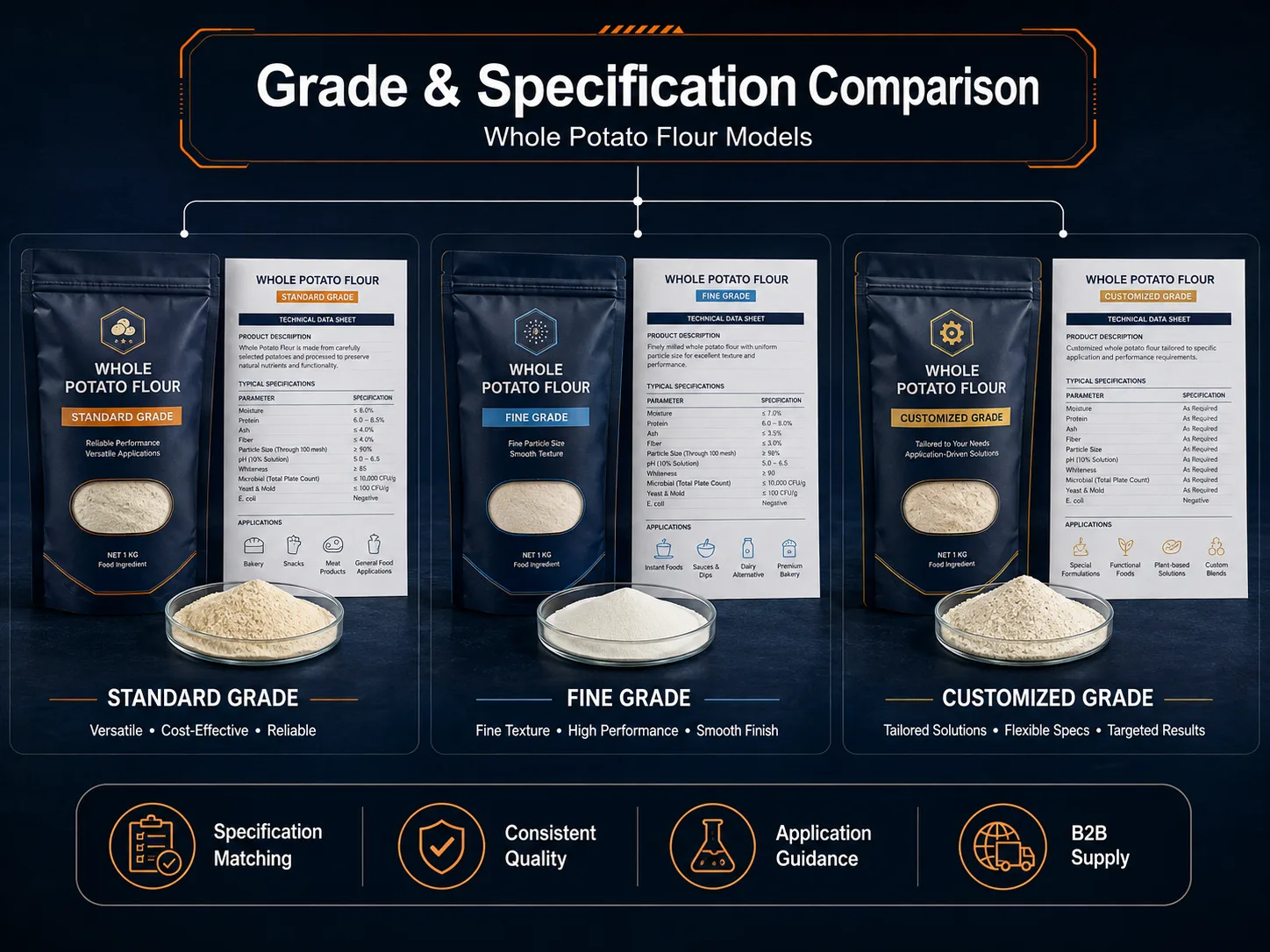
Grade & Model Comparison · Specification-Led Sourcing
Economy, food, bakery, feed and bulk are commercial labels, not technical guarantees. This page explains how grade systems differ inside each whole-potato form — flakes, granules, pregelatinized flour and dehydrated flour — and which parameters you should compare before signing a specification.
Grade systems at a glance
Each whole-potato form carries its own grade ladder. The typical grades below describe direction only — the signed specification and the lot COA define the purchase.
Fast-rehydrating flake form for mash, fabricated chips, snacks, bakery and binding.
Fine-granule form for uniform reconstitution, precise dosing and bakery dough systems.
Cold-water thickening and instant functionality for dry mixes, soups and sauces.
Fine whole-potato powder for moisture retention, seasoning and dry blending.
Reference comparison
Reference limits follow USDA A-A-20032H (White Potatoes, Dehydrated); residual sulphites must also meet the 400 mg/kg cap of EU Regulation (EC) 1333/2008 for dehydrated potato products.
| Parameter | Whole Potato Flakes | Whole Potato Granules | Pregelatinized Whole Potato Flour | Dehydrated Potato Flour |
|---|---|---|---|---|
| Product form | Flake — fast rehydration, classic mash texture | Fine granule — uniform reconstitution, precise dosing | Fine powder — cold-water dispersible, rapid viscosity build | Fine powder — hydration, dry blending, flavour delivery |
| Moisture reference | ≤ 9.0% | ≤ 9.5% | Per signed specification | Per signed specification |
| Reducing sugars reference | ≤ 4.0% | ≤ 4.0% | Application-dependent | Application-dependent |
| Sulphite as SO₂ reference | ≤ 500 mg/kg (USDA); EU 1333/2008 cap 400 mg/kg | ≤ 600 mg/kg (USDA); EU cap 400 mg/kg | Destination compliant (EU ≤ 400 mg/kg; GB 2760) | Destination compliant (EU ≤ 400 mg/kg; GB 2760) |
| Microbial reference | APC < 100,000 CFU/g; Salmonella negative | Yeast & mould < 100 CFU/g | Per signed specification & COA | Per signed specification & COA |
| Typical grades | Economy / Food / Bakery / Feed / Bulk | Food / Bakery / Bulk | Food / Bakery | Food / Economy / Bulk |
| Typical uses | Instant mash, fabricated chips, snacks, bakery, pet food & feed binding | Instant mash, bakery doughs, frozen prepared foods | Instant soups, sauces, gravies, dry mixes, bakery | Bread & rolls, seasonings, dry mixes, soup bases |
Reference values are not contractual guarantees. Contractual limits, test methods and acceptance rules are fixed in the signed specification and verified by the lot COA.
Names versus performance
The same label can hide very different products between factories. Treat grade names as filters, never as specifications.
"Food grade" at factory A can be a different product at factory B. Names are commercial labels; only the agreed specification states limits, methods and acceptance rules.
A grade name cannot replace a signed specification. Confirm the moisture basis (as-is vs dry), the reducing-sugar definition, the SO₂ cap and the test methods before comparing offers.
Grade labels describe direction. Check every shipment against the lot COA for moisture, reducing sugars, sulphite, microbiology and colour — the values that actually reach your line.
Rehydration, viscosity and colour must be tested with your water ratio, mixer and process. A grade name predicts nothing about behaviour in your system.
Selection guidance
Directional guidance only. Confirm the grade with a laboratory trial under your process conditions and a signed specification.
| End product | Recommended grade | Why | Product |
|---|---|---|---|
| Instant mashed potato & rehydrated side dishes | Food grade flakes or granules | Fast rehydration and classic mash texture at food-grade limits. | food-grade-potato-flakes ↗ |
| Fabricated chips, formed snacks & pellets | Bakery / food grade flakes | Controlled reducing sugars and flake size for fry colour and dough body. | food-grade-potato-flakes ↗ |
| Bread, rolls & bakery dough systems | Food grade granules or flour | Uniform rehydration and fine dosing for moisture retention and soft crumb. | bakery-potato-granules ↗ |
| Instant soups, sauces & dry mixes | Pregelatinized flour | Cold-water dispersibility and rapid viscosity build shorten preparation. | instant-thickening-potato-powder ↗ |
| Pet food & feed binding | Feed grade flakes | Controlled hydration and structure at feed-grade cost targets. | feed-potato-flakes ↗ |
| High-volume, cost-driven formulations | Economy grade flakes | Standard specs at economy pricing where colour and texture tolerance allow. | economy-potato-flakes ↗ |
Grade FAQ
Ask both suppliers for a signed specification and a lot COA covering the same parameters: moisture (state as-is or dry basis), reducing sugars, sulphite as SO₂, microbiology, colour, bulk density and particle distribution. Use USDA A-A-20032H as a benchmark — for the potato flakes grade, references are moisture ≤ 9.0%, reducing sugars ≤ 4.0%, SO₂ ≤ 500 mg/kg, APC < 100,000 CFU/g and Salmonella negative, while the potato granules grade references ≤ 9.5% moisture, SO₂ ≤ 600 mg/kg and yeast & mould < 100 CFU/g. Remember that any dehydrated potato product exported to the EU must also respect the 400 mg/kg SO₂ cap of Regulation (EC) 1333/2008. Request samples drawn from the same lot as the COA, run identical trials with the same water ratio, mixer and measurement method, then compare the numbers line by line — if they differ, the two grades share only the name.
Upgrading usually means tighter moisture, colour or microbial limits, which can change hydration speed and finished texture; downgrading may relax reducing sugars or SO₂ limits, affecting fry colour, flavour or destination compliance. In practice the difference between a food grade potato flour and an economy grade of the same form is often a few tenths of a percent of moisture and a different SO₂ target — enough to shift dough handling and shelf life. Under USDA A-A-20032H, flakes grade moisture sits at ≤ 9.0% while granules run ≤ 9.5%, and SO₂ must stay within the 500–600 mg/kg reference range — and under the 400 mg/kg EU cap of Regulation (EC) 1333/2008 for dehydrated potato products. Revalidate water addition, mixing time and target texture whenever the grade changes, check a fresh lot COA for reducing sugars and bulk density, and trial with your own water ratio and mixer before locking the new grade into your specification.
Grades with tight specifications (food, bakery) are usually produced on dedicated runs, so MOQs tend to be higher or fixed; economy and bulk grades can often be consolidated from stock with lower MOQs. This is a production-planning reality at any China supplier: a dedicated run of food grade potato flour for a full container has different economics than pulling economy grade flakes from warehouse stock. The relationship also affects price — tighter grades carry more raw-material selection and screening cost, which shows in the per-ton price, while bulk grade volume unlocks the best price per kilogram. Ask for the MOQ of the exact grade you need, not of the product family, together with the price curve from trial container to annual contract, and confirm that the MOQ lot ships with a matching COA.
Particle distribution, rehydration behaviour, bulk density, colour consistency between lots, microbial results on the COA, sulphite compliance with destination rules (EU 1333/2008, GB 2760), packaging, transit time and the supplier's ability to hold a specification across seasons. For the potato flakes grade, also verify flake-size distribution and clump resistance; for the potato granules grade, check granulation uniformity because it drives dosing accuracy. Keep the USDA A-A-20032H references as your floor — moisture ≤ 9.0% for flakes and ≤ 9.5% for granules, reducing sugars ≤ 4.0% — and remember the EU 400 mg/kg SO₂ cap for dehydrated potato products. A low price on a loose spec usually reappears as process variation: ask the China supplier for three consecutive lot COAs and a trial run before comparing price per ton.
Start from your target: if fry colour is critical, the food grade potato flakes specification with reducing sugars ≤ 4.0% (USDA A-A-20032H) is the safer anchor, because higher reducing sugars darken fried colour. If the finished product tolerates colour shift, economy grade flakes at a lower price per ton can work — but check the lot COA for moisture (≤ 9.0% reference), SO₂ (≤ 500 mg/kg USDA, ≤ 400 mg/kg EU 1333/2008) and microbiology (APC < 100,000 CFU/g, Salmonella negative). Ask the China supplier for both specifications side by side, request samples of both grades from the same season's raw potatoes, and run identical fry trials with your water ratio, oil temperature and batter before choosing. This is the grade vs model comparison done with data, not names.
There is no single number: the MOQ depends on the grade, the form, the season and the packaging. As a rule at our factory, economy and bulk grade flakes can be consolidated from stock at a lower MOQ, while food grade potato flour and bakery-grade granules need dedicated runs with a higher, fixed MOQ — typically from one full container. Price moves with grade for a reason: tighter moisture, reducing sugars and microbial limits mean more raw-material selection and screening, so the price per ton climbs from bulk grade to economy grade to food grade. Ask for the MOQ and the price curve for the exact grade you need, plus a trial lot COA, and compare like for like across suppliers.
The two forms are made for different jobs, so their specifications differ in texture-relevant parameters. Under USDA A-A-20032H, flakes grade moisture is ≤ 9.0% and granules ≤ 9.5%, while reducing sugars stay ≤ 4.0% in both; sulphite differs — flakes ≤ 500 mg/kg SO₂, granules ≤ 600 mg/kg — and both must respect the EU 1333/2008 cap of 400 mg/kg for dehydrated potato products. Bulk density is the practical difference: granules pack denser and dose more precisely, flakes rehydrate faster. Microbiologically, flakes reference APC < 100,000 CFU/g with Salmonella negative, while granules reference yeast & mould < 100 CFU/g. Ask the China supplier for a side-by-side specification and lot COA for the exact grade — this is the real grade vs model comparison before you commit.
Authoritative references
Send the finished product, water ratio, process and target result — we return comparable samples with COA-backed grade guidance.
Start a grade comparison inquiry
Share the grade name you currently buy, its specification and your application — we prepare side-by-side specs, COAs and samples.
APPLICATION FIT · FORMULATION & LINE TRIAL
Application pages are most useful when the ingredient is evaluated under your real water ratio, mixing sequence, temperature, shear and holding time. Compare forms by the result they produce in the finished food, not by name alone.
Record texture, hydration or viscosity, colour, yield and processing stability during the trial. Use those results to select a grade and define the specification fields that matter to your line.
Define water addition, mixing, heat, shear and downstream process.
Measure the finished-product results that matter to the application.
Select the form and specification after a controlled side-by-side trial.