
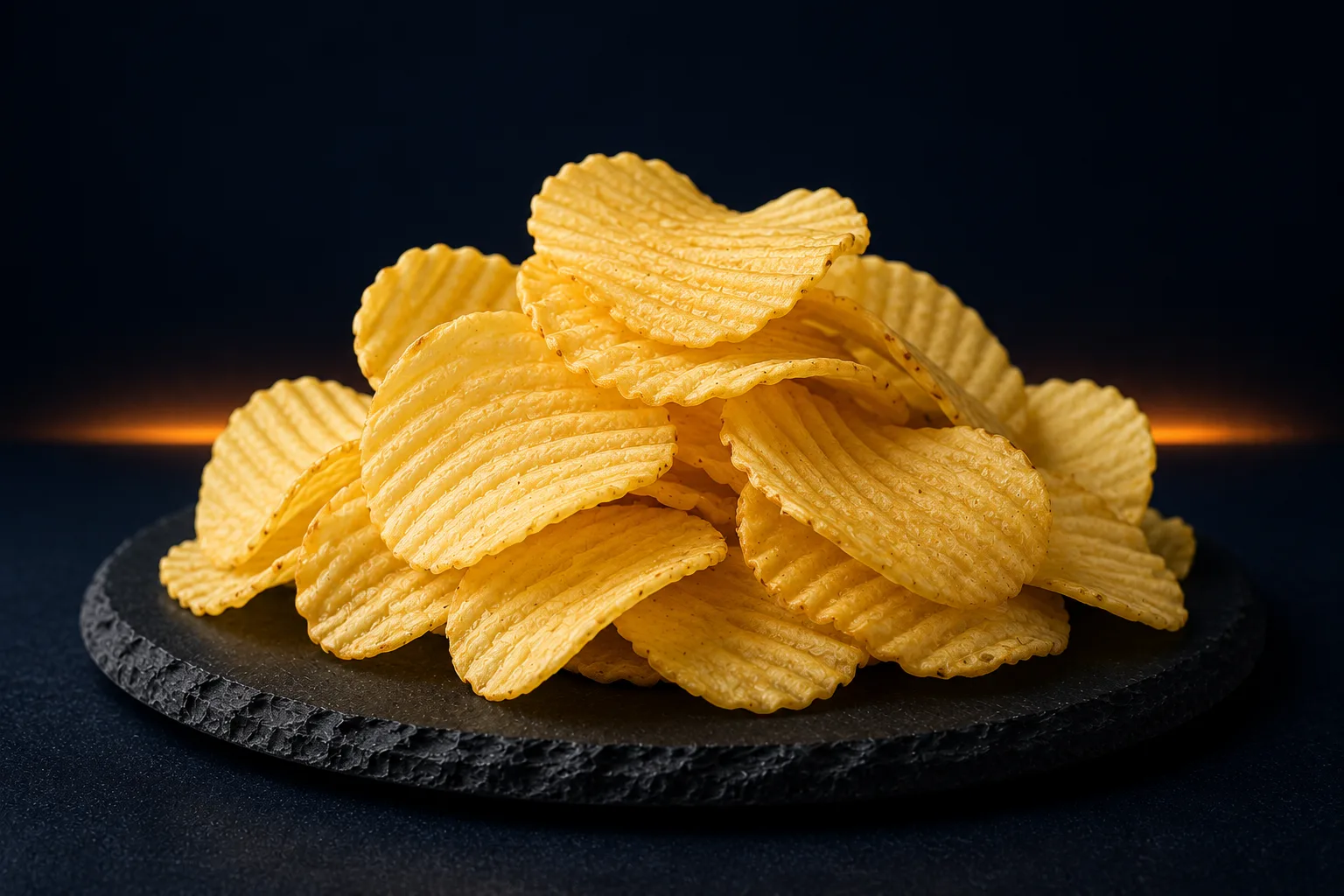
Fabricated chips & formed snacks
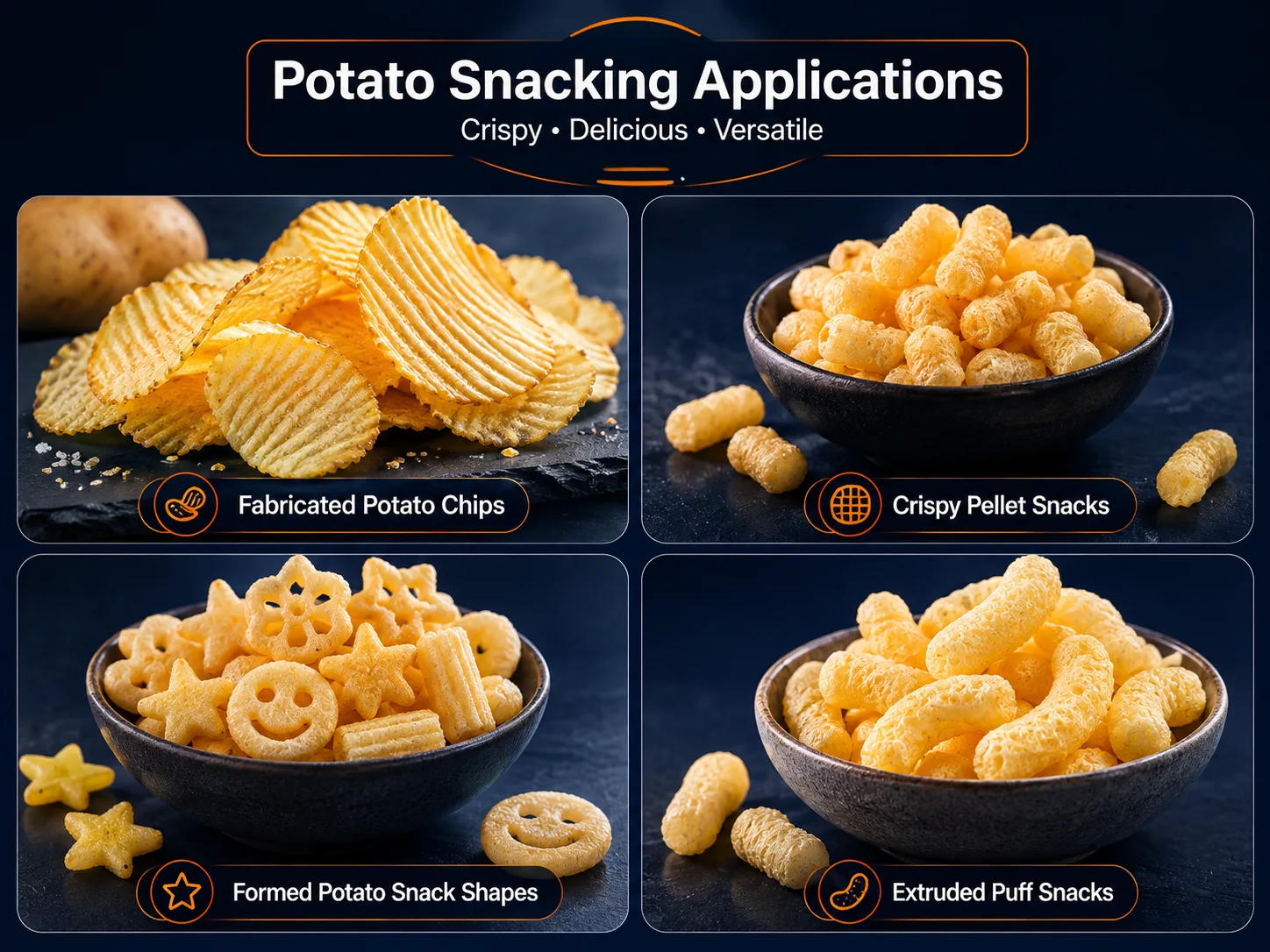
Snack Food Applications · Potato Ingredients for Snack Lines
How whole-potato flakes, granules and pregelatinized potato flour behave in fabricated chips, formed snacks, pellets and puffed snacks — and the measurable parameters that decide the grade.
Application scenarios
Each snack category places different demands on potato solids, hydration, dough handling and fry colour. Start from the finished product, then fix the parameter set.
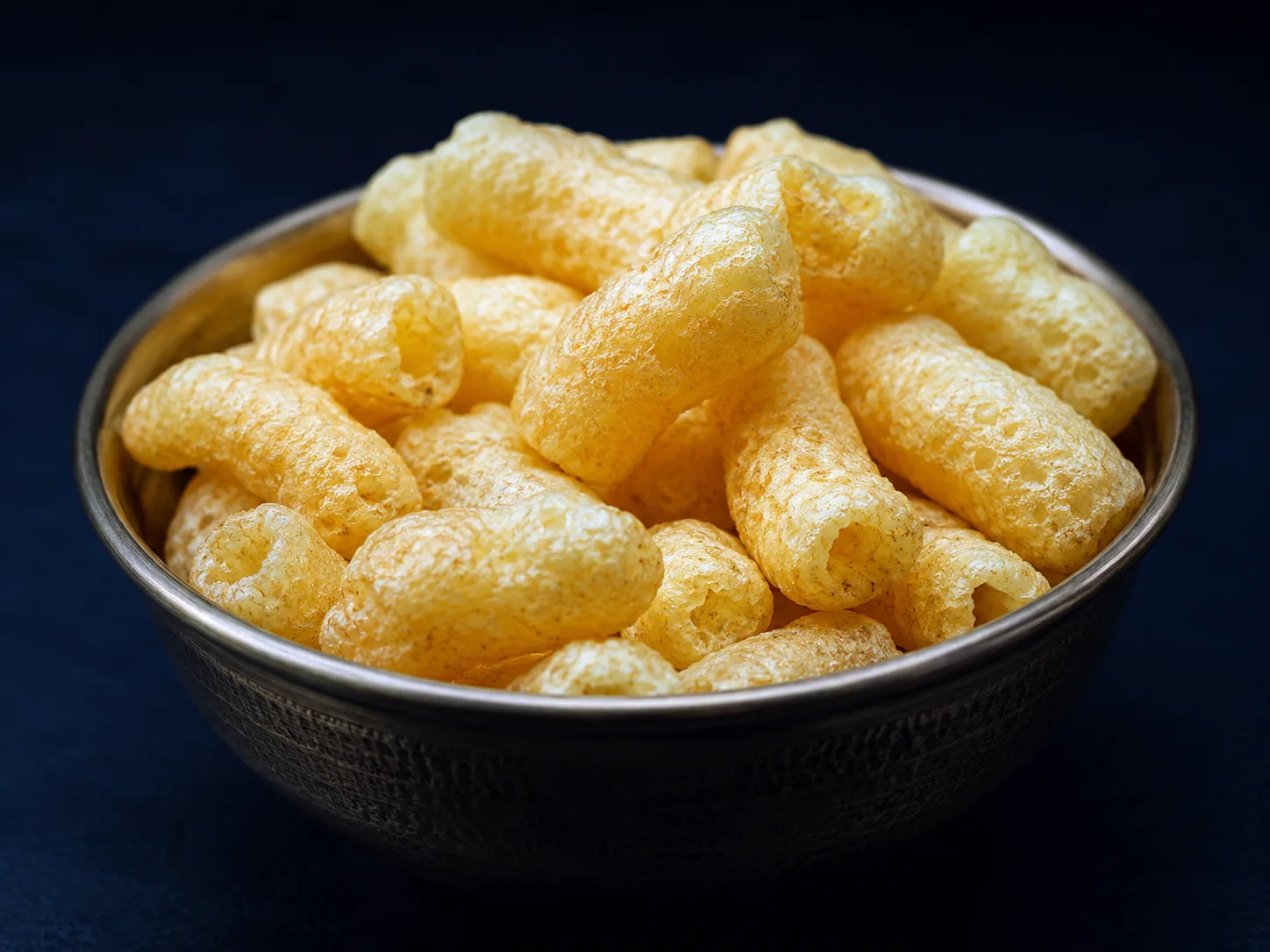
Key parameters
The same potato ingredient behaves differently as reducing sugars, particle profile and moisture change. These parameters decide fry colour, dough handling and batch-to-batch consistency.
Reducing sugars drive Maillard browning, flavour development and colour consistency. USDA A-A-20032H gives a reference limit of ≤4.0% for flakes; final fried colour also depends on oil temperature, time, oil type and dough moisture.
Flake size and fines distribution change hydration speed and sheeting behaviour: coarse flakes hydrate differently from fine powder, so the distribution must be matched to your mixer and water ratio.
Water ratio, hydration time and dough moisture govern sheeting, die fill and expansion. Test hydration with your own water before scaling the grade.
Reference moisture: flakes ≤9.0%, granules ≤9.5%. Lower, well-controlled moisture supports stable hydration behaviour and long-distance shipment.
Lot control of reducing sugars, moisture, colour and particle profile keeps fry colour and texture repeatable run after run.
Sulphite must meet destination rules: EU 1333/2008 sets 400 mg/kg (as SO₂) for dehydrated potato products; flakes carry a USDA reference of ≤500 mg/kg.
Selection guide
Reference direction only. Confirm the grade with a laboratory trial under your actual process conditions.
| Finished snack product | Recommended ingredient | Parameters to watch |
|---|---|---|
| Fabricated potato chips | Potato flakes | Reducing sugars ≤4.0% ref., flake size, dough moisture, fry colour |
| Formed snacks (sheeted, die-cut) | Potato flakes (± pregelatinized flour) | Hydration, sheetability, fines, water absorption |
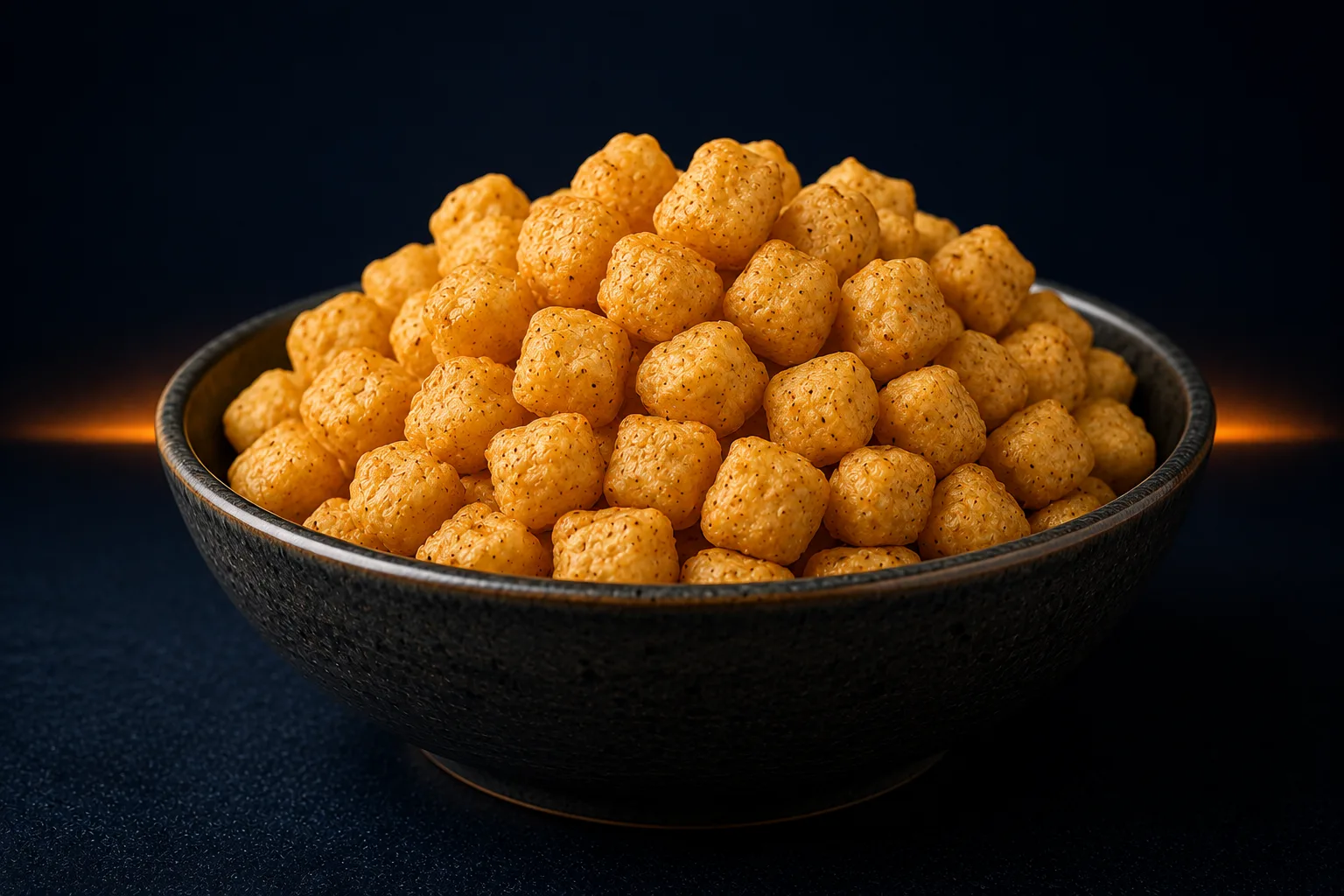
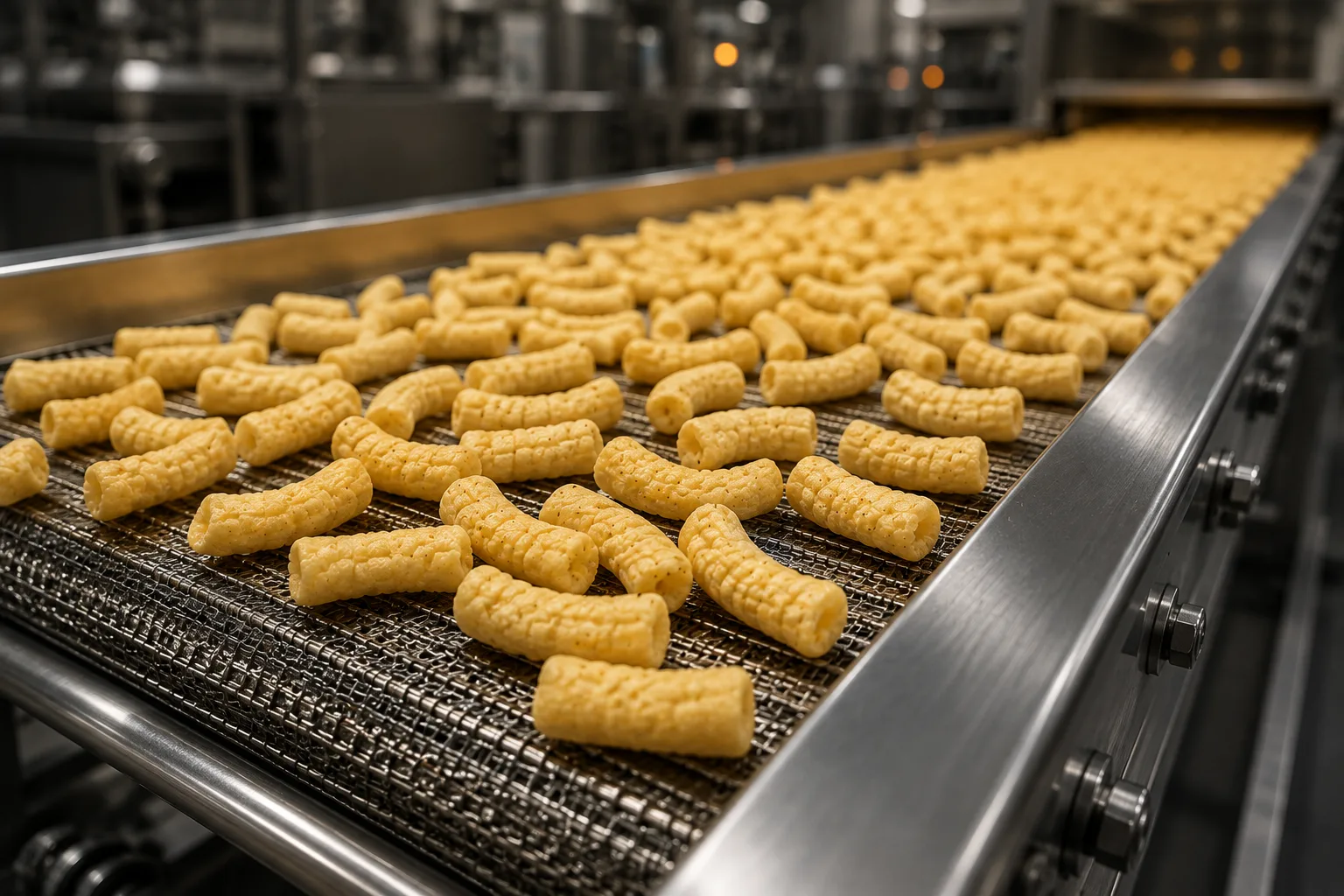
| Third-generation pellets | Potato flakes or granules | Moisture ≤9.0 / 9.5% ref., uniform rehydration, resting time |
| Extruded & puffed snacks | Pregelatinized flour + flakes | Cold-water function, binding, expansion consistency |
| Restructured potato products | Potato granules | Uniform rehydration, fine mouthfeel, freeze–thaw stability |
| Batter coatings & seasonings | Pregelatinized flour or flour | Cold-water dispersibility, fineness, colour, SO₂ compliance |
Values in the signed specification and lot COA, not this table, govern the purchase.
Snack FAQ
Start with reducing sugars: specify them against the USDA A-A-20032H reference limit of ≤4.0% for potato flakes for snacks and verify every lot COA before the container ships. Then check the process side — fry oil temperature, fry time, oil turnover and dough moisture — because Maillard browning, fry colour and flavour development depend on all of them together, not on the ingredient alone. Look at flake size and fines distribution as well: a finer fraction hydrates faster and can shift dough moisture and colour in fabricated chips (复合薯片) and formed snacks. Fix a fry test under constant time, temperature and oil, keep a reference lot for comparison, and validate the dough-moisture target on your own line before scaling the grade.
Run controlled fry trials with two lots of the same flake grade that differ in reducing sugars (还原糖), keeping dough moisture, oil temperature, fry time and fryer load identical. Measure colour objectively — for example L/a/b values — and correlate the result with the COA reducing-sugar figure, repeating each trial in triplicate across shifts to filter out process drift. A graded series of reducing-sugar levels (for example 2.0%, 3.0% and 4.0% reference) builds a colour curve you can reuse for future lot approval of potato flakes for snacks. This separates the ingredient contribution to fry colour from oil and line variation and gives your quality team a repeatable acceptance test.
Choose whole potato flakes when you need potato solids, dough body (面团主体) and a distinct bite in fabricated chips, formed snacks and sheeting lines; the flake form also gives the open, rough structure that helps the dough hold together. Choose granules when you need more uniform rehydration, a finer, smoother mouthfeel and fewer lumps in restructured systems. For pellet snacks and snack pellet production both candidates work, so test them side by side with your own water ratio, mixer and resting time, then measure sheeting, expansion and surface finish. Confirm flake size and fines against your equipment, and check the lot COA moisture as well — the reference is ≤9.0% for flakes and ≤9.5% for granules — because moisture, hydration speed and dough body change together with the particle profile.
When dough water is limited, mix time is short, or you need cold-water binding and rapid viscosity without cooking — typical for extruded snacks (膨化零食), batter coatings and dry seasoning systems. Pregelatinized potato flour hydrates and thickens in seconds even in cold water, so it builds dough body and water absorption in partially hydrated snack doughs where flakes alone would need longer mixing. Combine it with flakes at a modest dosage and watch tack: because it absorbs water fast, overdosing raises dough moisture and stickiness. Start with a low proportion of the total potato solids, adjust by trial, and validate the blend on your own line before committing the grade.
Stickiness usually comes from excess water, too many fines, or an over-dosed pregelatinized ingredient, so control the water-to-ingredient ratio and the hydration time first. Confirm the fines content and water absorption (吸水率) of your potato flakes for snacks: a grade with high fines or high water absorption may need less added water to reach the same dough body. Re-balance the pregelatinized potato flour dosage if tack rises, let the dough rest and relax before sheeting, and set a dough-moisture target validated on your own line with your own oil and fryer. Record the water addition per batch so the correction stays repeatable in fabricated chips and formed snacks.
Choose potato flakes for snacks with a signed reducing-sugar limit against the USDA A-A-20032H reference (≤4.0%) so that fabricated chips (复合薯片) brown consistently in the fryer. Match flake size and fines distribution to your mixer and sheeter: coarse flakes hydrate slower and give a firmer dough body, while fine material hydrates fast and can shift dough moisture and fry colour between batches. Verify the water absorption of the grade and run a batch validation fry test at your fixed oil temperature and time before approving the lot, because Maillard browning depends on oil temperature, fry time, oil turnover and dough moisture together. Ask for the lot COA and keep a reference lot for side-by-side comparison in snack pellet production, pellet snacks and formed snacks as well.
The ingredient that prevents sticky dough is the one with controlled water absorption and a stable fines profile: whole potato flakes for snacks (零食用马铃薯雪花片) with a defined particle distribution, or granules where you need uniform rehydration in formed snacks and restructured lines. Stickiness is usually a ratio problem — too much water, too many fines, or too much pregelatinized potato flour in the mix, all of which raise dough moisture and tack. Set the water-to-ingredient ratio against the COA water absorption, keep the pregelatinized dosage low, and validate the dough body on your own line. In extruded snacks and pellet snacks the same principle applies: measure hydration, sheet and relax the dough, then adjust before the batch reaches the fryer.
For snack applications, we manufacture potato flakes, potato granules and pregelatinized potato flour, with bulk supply available by container with a commercial MOQ per grade, packaging form and destination. The MOQ is confirmed in the commercial offer rather than published, because it depends on grade, pack size and port; trial lots for process validation are discussed separately. Every bulk shipment carries a lot COA with reducing sugars, moisture (≤9.0% reference for flakes), SO₂ (USDA A-A-20032H reference ≤500 mg/kg; EU 1333/2008 allows 400 mg/kg) and particle profile, so your fabricated chips, formed snacks and snack pellet production can verify the grade on arrival. Send the snack product, water addition, fry or bake profile, target colour and annual volume to our export team for the current offer.
Authoritative references
Send the finished product, water addition, frying or baking profile and target result — we return a grade recommendation with comparable samples.
Start a snack ingredient inquiry
Share the snack product, process conditions, target colour and texture, and volume for a grade recommendation.
APPLICATION FIT · FORMULATION & LINE TRIAL
Application pages are most useful when the ingredient is evaluated under your real water ratio, mixing sequence, temperature, shear and holding time. Compare forms by the result they produce in the finished food, not by name alone.
Record texture, hydration or viscosity, colour, yield and processing stability during the trial. Use those results to select a grade and define the specification fields that matter to your line.
Define water addition, mixing, heat, shear and downstream process.
Measure the finished-product results that matter to the application.
Select the form and specification after a controlled side-by-side trial.